
Gin Rummy is a two-player card game played with a standard 52-card deck. The goal is to form melds — sets and runs of cards — while keeping the total value of your unmatched cards as low as possible.
Unlike many card games, Gin Rummy has no wild cards, no shared community cards, and no betting. Every round is a direct head-to-head contest of hand management and timing. Skill matters far more than luck over any reasonable number of hands.
Each round is fast — usually 5 to 15 minutes — but a full game is played over several rounds until one player reaches 100 points.
What You Need to Play Gin Rummy
- Players: 2
- Deck: 1 standard 52-card deck (no jokers)
- Target score: 100 points (house rules may vary)
Card Values
Card values matter only for counting deadwood — they have no effect on which melds you can form.
| Card | Value |
|---|---|
| Ace | 1 point |
| 2 through 10 | Face value |
| Jack, Queen, King | 10 points each |
Face cards are the most dangerous cards to hold as deadwood — each one costs you 10 points if you are caught with it at the end of a round.
Key Terms You Need to Know
Meld — a valid combination of cards placed on the table when a round ends. There are two types: sets and runs.
Set — three or four cards of the same rank. Example: 9♠ 9♦ 9♥
Run — three or more consecutive cards of the same suit. Example: 4♣ 5♣ 6♣
Deadwood — any card in your hand that is not part of a meld. Your deadwood total is the sum of the values of these unmatched cards.
Knocking — ending the round by placing your discard face down and announcing your deadwood total. You may only knock if your deadwood is 10 points or less.
Going gin — ending the round with zero deadwood — all 10 cards in valid melds. The strongest possible finish.
Undercut — when you knock but your opponent has equal or lower deadwood than you. Your opponent wins the round instead.
Stock pile — the face-down pile of remaining cards. Players draw from here when they do not want the discard.
Discard pile — the face-up pile of discarded cards. The top card is always available to draw.
Layoff — when your opponent knocks, you may add cards from your hand onto their melds to reduce your deadwood before the scores are compared. You cannot lay off if your opponent goes gin.
Setup
- Shuffle the deck thoroughly
- Deal 10 cards to each player, one at a time, alternating
- Place the remaining cards face down in the centre — this is the stock pile
- Turn the top card of the stock pile face up beside it — this starts the discard pile
- The non-dealer takes the first turn
On the very first turn, the non-dealer may take the face-up card or pass. If they pass, the dealer may take it or pass. If both pass, the non-dealer draws from the stock pile and normal play begins.
How a Turn Works
Every turn follows the same three steps, in order.
Step 1 — Draw one card
You draw either:
- The top card of the stock pile (face down — your opponent does not see it), or
- The top card of the discard pile (face up — both players can see it)
Drawing from the discard pile gives your opponent useful information about your hand. Do it when the card is genuinely valuable — not out of habit.
Step 2 — Arrange your hand
You may organise your cards into potential melds at any point. Your melds stay hidden — your opponent cannot see your hand until the round ends.
Step 3 — Discard one card
End your turn by placing one card face up on the discard pile. You must always finish your turn with exactly 10 cards in hand.
Choose your discard carefully. Throwing a card your opponent just discarded is usually safe. Throwing cards they have been picking up from the discard pile is risky.
Melds in Detail
Sets
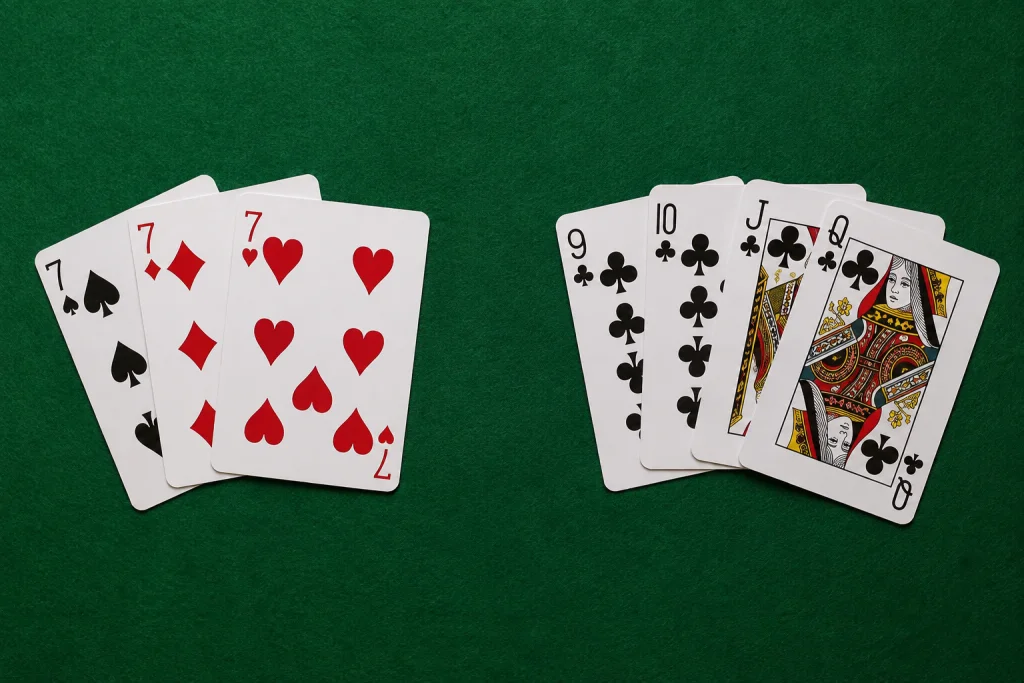
A set is three or four cards of the same rank.
Valid sets:
- 7♠ 7♦ 7♥ — three sevens, three different suits ✓
- K♠ K♦ K♥ K♣ — all four kings ✓
Invalid sets:
- 7♠ 7♦ — only two cards, need at least three ✗
- 7♠ 7♠ 7♦ — duplicate suits are not allowed in standard Gin Rummy ✗
Runs
A run is three or more consecutive cards of the same suit.
Valid runs:
- 4♣ 5♣ 6♣ — three clubs in order ✓
- 9♥ 10♥ J♥ Q♥ — four hearts in order ✓
- A♠ 2♠ 3♠ — ace plays low, starting a run ✓
Invalid runs:
- 4♣ 5♦ 6♣ — mixed suits, not a valid run ✗
- Q♠ K♠ A♠ — ace does not play high in Gin Rummy ✗
- 4♣ 6♣ 7♣ — gap in the sequence ✗
A card can only be used in one meld. You cannot use the same card in both a set and a run.
Knocking
Knocking ends the round. You may knock at the end of your turn — after drawing and before discarding — if your deadwood total is 10 points or less.
To knock:
- Discard your chosen card face down
- Announce “knock” (or simply place the card face down)
- Both players lay their hands face up on the table
- Separate your melds from your deadwood and announce your deadwood total
- Your opponent may then lay off cards onto your melds to reduce their own deadwood
Example knock:
You have these melds: 5♠ 6♠ 7♠ and 9♦ 9♥ 9♣ Your remaining cards: J♦ and A♥ (deadwood = 10 + 1 = 11)
You cannot knock — 11 is over the limit.
You draw 2♠ and discard J♦. Your remaining cards: 2♠ and A♥ (deadwood = 2 + 1 = 3)
Now you can knock with 3 deadwood.
When NOT to knock
Knocking early with 8 or 9 deadwood is tempting but risky. If your opponent has been playing quietly and has a strong hand, they may undercut you. Generally, the lower your deadwood when you knock, the safer you are.
Going Gin
You go gin when all 10 cards in your hand are part of valid melds — zero deadwood.
Going gin is more valuable than knocking:
- You score your opponent’s full deadwood total
- You receive a gin bonus of 25 points on top
- Your opponent cannot lay off cards against a gin hand
Going gin is not always the right play. If you could knock with 2 deadwood now, or wait 3 more turns hoping to go gin, knocking is often the better choice — your opponent might go gin first.
👉 If you want to learn more: When to go Gin vs Knock
Layoffs
When you knock (but not when you go gin), your opponent may lay off cards from their hand onto your melds before deadwood is compared.
Example:
You knock with this meld: 4♠ 5♠ 6♠ Your opponent holds: 3♠ and 7♠ in their deadwood
They may lay off both the 3♠ (onto the start of your run) and the 7♠ (onto the end), reducing their deadwood by 10 points before the comparison.
This is why going gin is so valuable — it prevents all layoffs.
👉 Full explanation: Layoffs in Gin Rummy Explained
The Undercut
An undercut happens when you knock but your opponent’s deadwood is equal to or lower than yours.
Example:
You knock with 8 deadwood. Your opponent reveals 6 deadwood — lower than yours.
Result: your opponent wins the round, not you. They score the difference (8 − 6 = 2 points) plus an undercut bonus of 25 points.
The undercut is the most punishing outcome in Gin Rummy. It is why experienced players are cautious about knocking with higher deadwood totals — the risk of being undercut increases significantly above 5 or 6 deadwood.
👉 See a full breakdown here: How to Avoid Undercuts in Gin Rummy
How Scoring Works
Scoring happens at the end of each round.
If you knock and win: You score the difference between your deadwood and your opponent’s deadwood (after layoffs).
Example: you have 4 deadwood, opponent has 18 deadwood after layoffs → you score 14 points.
If you go gin: You score your opponent’s deadwood total + 25 gin bonus.
Example: opponent has 22 deadwood → you score 22 + 25 = 47 points.
If you are undercut: Your opponent scores the deadwood difference + 25 undercut bonus.
Example: you knock with 9, opponent has 7 → opponent scores (9 − 7) + 25 = 27 points.
Scores accumulate across rounds. The first player to reach 100 points wins the game. At that point, additional bonuses may apply — see the full scoring breakdown on the Gin Rummy Scoring page.
Full Worked Example Round
Here is a complete round from deal to scoring, with every card tracked so you can verify the totals yourself.
Setup:
- Player A is the non-dealer and goes first
- Both players are dealt 10 cards
Player A’s starting hand: K♥ Q♥ J♥ 10♥ | 7♣ 7♦ 7♠ | 4♦ 9♠ 2♣
Already strong: a run of K♥ Q♥ J♥ 10♥ and a set of three 7s. Deadwood: 4♦ (4) + 9♠ (9) + 2♣ (2) = 15.
Player B’s starting hand: A♠ 2♠ 3♠ | 5♥ 6♥ | 8♦ J♦ Q♣ K♣ 4♥
A run of A♠ 2♠ 3♠, plus a partial heart sequence that isn’t a meld yet. Deadwood: 5♥ (5) + 6♥ (6) + 8♦ (8) + J♦ (10) + Q♣ (10) + K♣ (10) + 4♥ (4) = 53.
Turn 1 — Player A: Draws 5♣ from stock. It doesn’t fit the run or the set, so it goes straight back onto the discard pile. Deadwood unchanged: 15.
Turn 1 — Player B: Draws 7♥ from stock. This completes 5♥ 6♥ 7♥ as a new run. Discards K♣ (10 points of deadwood gone). Remaining deadwood: 8♦ + J♦ + Q♣ + 4♥ = 32.
Turn 2 — Player A: Draws 3♦ from stock. It doesn’t fit any meld, but it’s cheaper deadwood than what’s already in hand — discards 9♠ instead, keeping 3♦. New deadwood: 4♦ (4) + 2♣ (2) + 3♦ (3) = 9.
Turn 2 — Player B: Draws 4♣ from stock. It pairs with 4♥, but two of a kind isn’t a meld yet — worth holding in case a third 4 turns up. Discards J♦ (10 points gone). Remaining deadwood: 8♦ + Q♣ + 4♥ + 4♣ = 26.
Turn 3 — Player A: Draws Q♦ from stock. Ten points of deadwood is far too risky to hold — discards it straight back. Deadwood stays at 9.
Player A knocks with 9 deadwood.
Reveal:
- Player A’s melds: K♥ Q♥ J♥ 10♥ (run) + 7♣ 7♦ 7♠ (set). Deadwood: 4♦ + 2♣ + 3♦ = 9.
- Player B’s melds: A♠ 2♠ 3♠ (run) + 5♥ 6♥ 7♥ (run). Deadwood: 8♦ + Q♣ + 4♥ + 4♣ = 26.
Layoffs: Player B checks Player A’s melds. The heart run is already capped at King — nothing extends above it. The set of 7s would need the fourth 7♥, but that card is already committed to Player B’s own run. No layoffs possible.
Score: 26 − 9 = 17 points for Player A.
(Player A’s knock at 9 deadwood is on the risky side — right at the edge of what’s usually recommended — which is exactly the kind of decision the “When Not to Knock” section above is warning about. It worked out here, but it’s a real gamble against a stronger hand.)
Common Beginner Mistakes
1. Knocking too early with high deadwood Knocking with 9 or 10 deadwood feels safe because it is within the rules, but it leaves you very exposed to an undercut. Aim to knock with 6 or fewer when possible.
2. Drawing from the discard pile too often Every card you take from the discard pile tells your opponent exactly what you are building. Take from the discard only when the card is immediately useful and worth the information cost.
3. Holding face cards too long Jacks, Queens, and Kings are worth 10 points each. Three face cards in your deadwood is 30 points — a devastating undercut target. Discard them early unless they are already in a meld.
4. Ignoring what your opponent discards The discard pile is information. If your opponent keeps throwing mid-range cards, they are likely holding face cards or building low runs. Adjust your strategy accordingly.
5. Chasing gin when knocking is the right move Going gin scores more, but waiting for perfection while your opponent knocks with 4 deadwood costs you the round. Take the bird in hand.
6. Forgetting layoffs When your opponent knocks, always check their melds carefully before announcing your deadwood. A layoff can be the difference between winning and losing a round.
Gin Rummy Variations
Oklahoma Gin The most widely played variation. The face-up card turned at the start of the round determines the maximum deadwood you need to knock. If a 4 is turned up, you must have 4 deadwood or less to knock. If an ace is turned up, you must go gin. Spades turned up doubles the round’s score.
👉 Check out: Gin Rummy vs Oklohoma Gin
Three-handed Gin Rummy One player sits out each round while the other two play. The sitting-out player partners with the winner of each round. Not official but common in casual play.
Quick Reference
| Situation | Result |
|---|---|
| You knock, lower deadwood | You score the difference |
| You go gin | You score opponent’s deadwood + 25 |
| You knock, opponent equal or lower | Opponent scores difference + 25 |
| Opponent lays off cards | Reduces their deadwood before comparison |
| Ace value | 1 point (low only) |
| Face card value | 10 points each |
| Knock limit | 10 deadwood or less |
| Target score | 100 points |
Where to Play Gin Rummy Online
You can play Gin Rummy:
- Against AI for practice
- Against real players online
- On free or real-money platforms (depending on location)
👉 Recommended next reads:
Gin Rummy FAQ
Is Gin Rummy skill or luck?
Short-term luck matters, but over time Gin Rummy is strongly skill-based.
Can you play Gin Rummy online for money?
Yes, depending on the platform and your country.
How many points are needed to win?
Most games are played to 100 points.
Final Thoughts
Gin Rummy rewards patience, observation, and restraint. Once the rules are understood, improvement comes from learning when not to act — when not to draw, not to knock, and not to chase risky melds.
To improve:
- Learn scoring deeply
- Watch discard patterns
- Play enough hands to recognize mistakes early
That’s where most games are decided.