
Layoffs are an important but often misunderstood part of Gin Rummy. Many beginners lose points because they don’t understand when layoffs are allowed, how they work, or how they affect scoring.
This guide explains layoffs in Gin Rummy clearly, with examples and practical implications.
What Are Layoffs in Gin Rummy?
A layoff occurs after a player knocks.
Once the knocker reveals their melds, the non-knocking player may add cards from their hand onto the knocker’s melds to reduce their own deadwood before scores are compared.
Layoffs:
- Happen only after a knock
- Are performed by the non-knocking player only
- Can be added to any of the knocker’s valid melds
- Reduce the non-knocker’s deadwood total before scoring
- Can completely change who wins the round
When Are Layoffs Allowed?
Layoffs are allowed only when:
- A player knocks, and
- The opponent reveals their hand with at least some deadwood remaining
Layoffs are not allowed when:
- A player goes gin
This distinction is critical. Going gin locks in your opponent’s deadwood at whatever it is the moment you announce gin — they get no opportunity to reduce it. This is one of the main reasons going gin is more valuable than knocking.
👉 Related guide: When to Go Gin vs Knock
What Cards Can Be Laid Off?
You may lay off cards that legally extend the knocker’s revealed melds. You cannot rearrange the knocker’s melds — only add to them.
Layoffs on Sets
You may add a fourth card of the same rank to a set of three.
Example:
Knocker’s meld: 8♠ 8♦ 8♥ (set of three 8s) You hold: 8♣
You may lay off 8♣ → set becomes 8♠ 8♦ 8♥ 8♣ Your deadwood reduced by 8 points.
Note: a set of four is the maximum. You cannot add a fifth card.
Layoffs on Runs
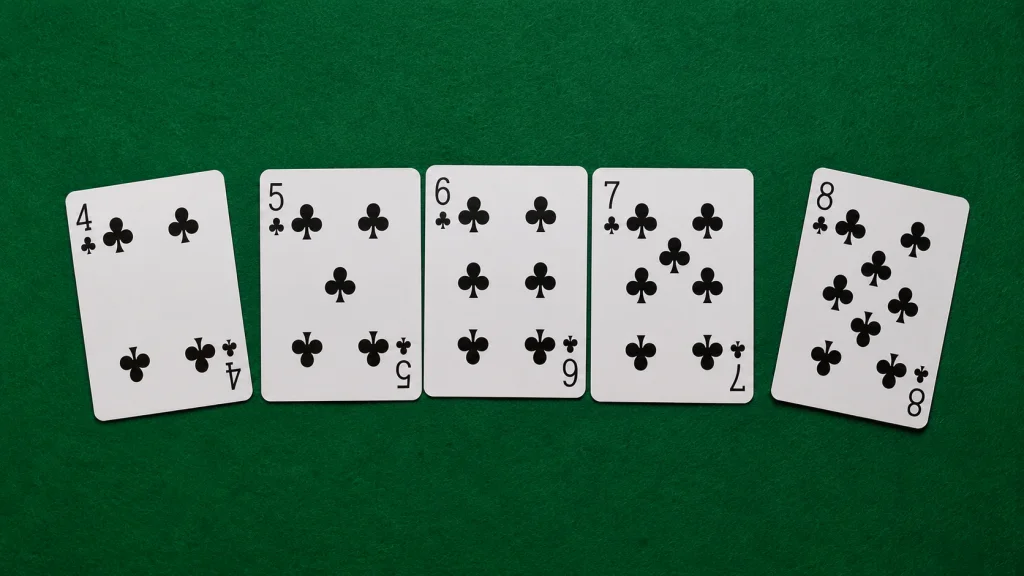
You may extend a run at either end by adding the next consecutive card of the same suit.
Example 1 — extending at the high end:
Knocker’s meld: 5♣ 6♣ 7♣ You hold: 8♣
You may lay off 8♣ → run becomes 5♣ 6♣ 7♣ 8♣ Your deadwood reduced by 8 points.
Example 2 — extending at the low end:
Knocker’s meld: 5♣ 6♣ 7♣ You hold: 4♣
You may lay off 4♣ → run becomes 4♣ 5♣ 6♣ 7♣ Your deadwood reduced by 4 points.
Example 3 — extending at both ends:
Knocker’s meld: 5♣ 6♣ 7♣ You hold: 4♣ and 8♣
You may lay off both → run becomes 4♣ 5♣ 6♣ 7♣ 8♣ Your deadwood reduced by 12 points.
What you cannot do:
- Insert a card into the middle of a run
- Lay off onto a meld using a card of the wrong suit
- Rearrange the knocker’s melds to create new layoff opportunities
How Layoffs Affect Deadwood and Scoring
After layoffs:
- The non-knocking player’s deadwood is recalculated based on remaining unmatched cards
- The knocker’s deadwood does not change
- Scoring is based on post-layoff deadwood totals
This means layoffs can:
- Reduce point losses significantly
- Create an undercut that would not have existed without layoffs
- Change who wins the round entirely
Example — layoffs reduce the margin
Player A knocks with 5 deadwood. Player B has 19 deadwood before layoffs.
Apparent margin: 19 − 5 = 14 points for Player A.
Player A’s melds include 9♠ 10♠ J♠. Player B holds 8♠ and Q♠ in deadwood.
Player B lays off 8♠ (run becomes 8♠ 9♠ 10♠ J♠) and Q♠ (run becomes 8♠ 9♠ 10♠ J♠ Q♠). Deadwood reduced by 8 + 10 = 18 points.
Player B’s remaining deadwood: 19 − 18 = 1 point.
Player B with 1 deadwood after layoffs vs Player A with 5 deadwood → Player B undercuts Player A.
Player B scores: (5 − 1) + 25 undercut bonus = 29 points
A round that looked like a 14-point win for Player A became a 30-point loss.
A Full Layoff Worked Example
Setup: Player A knocks.
Player A’s melds:
- 4♥ 5♥ 6♥ 7♥ (run)
- K♠ K♦ K♣ K♥ (set)
Player A’s deadwood: 3♣ + 2♦ = 5 points
Player B’s hand before layoffs:
- 8♥ 9♥ (partial run — deadwood)
- Q♣ (deadwood)
- J♦ (deadwood)
- 3♠ (deadwood)
- 2♣ 3♣ 4♣ 5♣ 6♣ (run)
Player B’s deadwood before layoffs: 8 + 9 + 10 + 10 + 3 = 40 points
Layoff phase:
Player B checks Player A’s melds.
- 4♥ 5♥ 6♥ 7♥: Can extend with 8♥ at the high end → run becomes 4♥ 5♥ 6♥ 7♥ 8♥. Deadwood reduced by 8.
- Now 9♥ also fits at the end → run becomes 4♥ 5♥ 6♥ 7♥ 8♥ 9♥. Deadwood reduced by another 9.
- K♠ K♦ K♣: Player B has no K♥. Cannot extend.
Player B lays off 8♥ and 9♥. Deadwood after layoffs: 40 − 8 − 9 = 23 points
Score: 23 − 5 = 18 points for Player A
Without layoffs it would have been 40 − 5 = 35 points. Layoffs cut Player A’s winnings nearly in half.
Why Layoffs Increase Undercut Risk
Layoffs are one of the main reasons undercuts happen when they seem unexpected.
Common pattern:
- You knock with 7 deadwood
- Your opponent has 15 deadwood — you feel safe
- Your meld includes 5♦ 6♦ 7♦
- Your opponent holds 4♦ and 8♦
- They lay off both → their deadwood drops from 15 to 3
- You get undercut: they score (7 − 3) + 25 = 29 points
The mistake was not the knock itself — 7 deadwood is reasonable. The mistake was not noticing that your run was open-ended and your opponent might hold the connecting cards.
Before knocking, always look at your melds and ask: what could my opponent add to these?
How to Reduce Layoff Risk When Knocking
You cannot prevent layoffs entirely, but you can reduce their impact:
Knock with lower deadwood
The lower your deadwood, the more layoffs your opponent needs to undercut you. With 2 deadwood, your opponent would need to lay off every single deadwood card to match you.
Avoid obvious open-ended runs
A run of 5♣ 6♣ 7♣ can be extended at both ends. A run of A♣ 2♣ 3♣ can only be extended at the high end (4♣). Runs near the edges of the sequence are harder to extend.
Complete sets rather than runs where possible
A four-card set cannot be extended further. Once you have K♠ K♦ K♣ K♥, there is nothing your opponent can add. Completed sets are layoff-proof.
Watch what your opponent has discarded
If your opponent discarded 8♦ two turns ago, they probably don’t hold 8♦ anymore. You can safely have a run that includes that slot without worrying about a layoff there.
Track which suits your opponent has been picking up
If they have taken three clubs from the discard pile, they may have a club run in progress. If your melds include a club run, a layoff from that suit is more likely.
Layoffs vs Going Gin
| Situation | Layoffs Allowed? | Why it matters |
|---|---|---|
| Player knocks | Yes | Opponent can reduce deadwood |
| Player goes gin | No | Opponent’s deadwood is locked |
This is why going gin:
- Is safer from reversals
- Prevents opponent recovery through layoffs
- Locks in the maximum scoring outcome
- Eliminates all undercut risk
If you go gin with your opponent holding 25 deadwood, you score 25 + 25 bonus = 50 points, no matter what cards they hold. If you knock with 3 deadwood and your opponent holds 25 deadwood, they might lay off 20 points of cards and your winning margin drops to 2 points.
Layoffs FAQ
Can I lay off onto a meld the knocker just built from table cards?
No — in standard Gin Rummy there are no table cards. All melds are revealed from each player’s hand at the reveal.
Can I choose not to lay off even if I could?
Yes. Layoffs are optional. If laying off a card would somehow disadvantage you (unlikely but possible in unusual situations), you may choose not to use it.
Can I lay off multiple cards in one turn?
Yes. After a knock you may lay off as many qualifying cards as you can legally add to the knocker’s melds, all at once.
Does the knocker get to respond to layoffs?
No. The layoff phase is one-way — only the non-knocking player lays off. The knocker’s melds and deadwood are fixed at the moment they knock.
What if my layoff creates a new meld opportunity?
Layoffs can only extend the knocker’s existing melds. You cannot create new melds during the layoff phase.
Common Layoff Mistakes
Forgetting layoffs exist
The most common mistake, especially among new players. After a knock, always pause and check every meld the knocker has revealed before counting your deadwood.
Not checking both ends of every run
Beginners often check whether they can add to the high end of a run but forget to check the low end. Check both.
Miscounting deadwood before and after layoffs
Lay off your cards first, then recount. Do not try to mentally calculate the adjusted total — physically separate the cards.
Knocking with exposed, easy-to-extend melds and high deadwood
This combination is the most dangerous. Open runs plus a 9 or 10 deadwood knock is asking for an undercut.
Assuming a large apparent deadwood gap is safe
If your opponent has 18 deadwood and you have 6, you feel comfortable. But if your melds are two open-ended runs, your opponent might be able to lay off 12+ points and close the gap to nothing.
Always consider possible layoffs before knocking.
Quick Layoff Checklist
When you are the knocker — before knocking:
- Do my melds have open ends that could be extended?
- Which suits has my opponent been drawing or holding?
- Is my deadwood low enough that even significant layoffs cannot undercut me?
- Would knocking with less deadwood (one more turn) be safer?
When you are the non-knocker — after opponent knocks:
- Check every meld the knocker has — sets and runs
- For sets: do I hold the missing suit?
- For runs: do I hold the card one below the bottom or one above the top?
- Lay off everything you legally can before counting your final deadwood