
If Gin Rummy scoring feels confusing, you’re not alone. Most beginners understand the rules of play but lose games because they don’t fully understand how points are actually awarded — especially when knocking, going gin, or getting undercut.
This page explains Gin Rummy scoring step by step, with clear examples and no assumptions. Once this makes sense, a lot of in-game decisions will start to feel much clearer.
How Scoring Works in Gin Rummy (Big Picture)
Gin Rummy scoring is based on deadwood — the total point value of cards in your hand that are not part of melds.
At the end of each round:
- Both players reveal their hands
- Deadwood is counted
- Points are awarded based on the difference
There are three main outcomes:
- Knocking
- Going Gin
- Undercut
We’ll go through each one.
👉 If you’re not sure how deadwood works, see:
What Is Deadwood in Gin Rummy
Card Values for Scoring
These values are used only for deadwood, not for meld strength:
- Ace = 1 point
- Number cards = face value
- Jack, Queen, King = 10 points
Lower deadwood = better position. Face cards are the most dangerous to hold — a single Jack, Queen, or King costs you 10 points if caught in your deadwood at the end of a round.
What Is Deadwood?
Deadwood is the total value of cards in your hand that are not part of any meld.
Example
If your hand contains:
- A run (5♣ 6♣ 7♣)
- A set (9♠ 9♦ 9♥)
- Two unmatched cards: K♦ and 3♠
Your deadwood is:
- K♦ = 10 points
- 3♠ = 3 points ➡ Total deadwood = 13
Deadwood determines when you can knock and how many points are scored.
Counting Deadwood Correctly
One thing beginners miss: always check every possible meld arrangement before counting. A card might fit in more than one combination — choose the arrangement that gives you the lowest deadwood total.
Example: You hold 7♠ 7♦ 7♥ and 5♠ 6♠ 7♣ and J♦.
You might think: use 7♠ 7♦ 7♥ as a set, leaving 5♠ 6♠ 7♣ as deadwood = 18 points.
But wait — 5♠ 6♠ 7♠ would be a run if you swap 7♠ into it. Now the set becomes 7♦ 7♥ 7♣ and the run becomes 5♠ 6♠ 7♠. Deadwood is now just J♦ = 10 points.
Always find the arrangement that minimises your deadwood before deciding whether to knock.
👉 Learn how deadwood affects decisions here:
When to Knock in Gin Rummy
Scoring When You Knock
You may knock if your deadwood total is 10 points or less.
When you knock:
- The round ends immediately
- Both players reveal their hands
- Your opponent may lay off cards onto your melds (more on this below)
- Deadwood totals are compared
How Points Are Awarded
If you have less deadwood than your opponent (after layoffs):
Opponent’s deadwood − Your deadwood = Points scored
Example: Knock Scoring
You knock with 8 deadwood Opponent has 22 deadwood after layoffs
Score: 22 − 8 = 14 points for you
This is the most common scoring outcome in Gin Rummy.
Another Example
You knock with 3 deadwood Opponent has 11 deadwood after layoffs
Score: 11 − 3 = 8 points for you
Smaller margin, but still a win. Consistent wins with low deadwood add up quickly over a full game.
⚠️ Knocking too early increases risk — see:
How to Avoid Undercuts in Gin Rummy
Going Gin (Best Possible Result)
You go gin when:
- All 10 cards in your hand are part of melds
- You have zero deadwood
This is the strongest finish in Gin Rummy.
Gin Scoring
When you go gin, you score:
- Your opponent’s full deadwood
- Plus a gin bonus (usually 25 points)
Your opponent cannot lay off any cards when you go gin — their deadwood total is final the moment you announce gin.
Example: Going Gin
You go gin (0 deadwood) Opponent has 18 deadwood
Score: 18 + 25 = 43 points
Another Example
You go gin (0 deadwood) Opponent has 35 deadwood
Score: 35 + 25 = 60 points
Going gin can swing an entire game in a single round. This is why preventing layoffs matters — knocking with 2 deadwood might net you 15 points, but going gin against the same opponent hand gets you 60.
👉 Deciding whether to wait for gin or knock is critical:
When to Go Gin vs Knock
What Is an Undercut?
An undercut happens when:
- You knock
- Your opponent has equal or lower deadwood than you (after layoffs)
If this happens:
- Your opponent wins the round, not you
- They receive an undercut bonus (usually 25 points)
- Plus the deadwood difference (if any)
Example: Undercut
You knock with 9 deadwood Opponent has 7 deadwood after layoffs
Score for opponent: (9 − 7) + 25 undercut bonus = 27 points
Example: Equal Deadwood Undercut
You knock with 6 deadwood Opponent has 6 deadwood after layoffs
Score for opponent: (6 − 6) + 25 = 25 points — just the undercut bonus
Even when deadwood is equal, the knocker loses. The undercut bonus always applies.
This is why knocking “as soon as possible” can be risky — many beginner losses come from undercuts, not bad hands. The higher your deadwood when you knock, the more vulnerable you are.
👉 See a full breakdown here:
How to Avoid Undercuts in Gin Rummy
Layoffs After Knocking (Important Detail)
After a player knocks (but not after gin):
- The non-knocking player may add cards (lay off) onto the knocker’s melds
- Each laid-off card reduces their deadwood total before scores are compared
Example of layoffs:
You knock with this meld: 5♠ 6♠ 7♠ Your opponent holds 4♠ and 8♠ in their deadwood
They lay off 4♠ at the start of your run and 8♠ at the end. Run becomes: 4♠ 5♠ 6♠ 7♠ 8♠ Their deadwood is reduced by 4 + 8 = 12 points.
If their remaining deadwood after layoffs is equal to or lower than yours — you get undercut.
⚠️ Layoffs are not allowed when a player goes gin. This is one of the main reasons going gin is so valuable.
👉 Full explanation:
Layoffs in Gin Rummy Explained
Full Scoring Example — One Complete Round
Here is a complete round from knock to final score.
Player A knocks.
Player A’s melds: 9♠ 10♠ J♠ Q♠ K♠ (run) and 4♥ 4♦ 4♣ (set) Player A’s deadwood: 3♣ + 2♦ = 5 points
Player B’s melds: 6♦ 7♦ 8♦ 9♦ 10♦ J♦ (run) Player B’s deadwood before layoffs: K♥ + Q♣ + 8♠ + 5♥ = 10 + 10 + 8 + 5 = 33 points
Layoffs: Player B checks Player A’s melds.
- 9♠ 10♠ J♠ — Player B has 8♠. They lay it off: 8♠ 9♠ 10♠ J♠. Deadwood reduced by 8.
- 4♥ 4♦ 4♣ — Player B has no 4♠. No layoff possible.
Player B’s deadwood after layoffs: 33 − 8 = 25 points
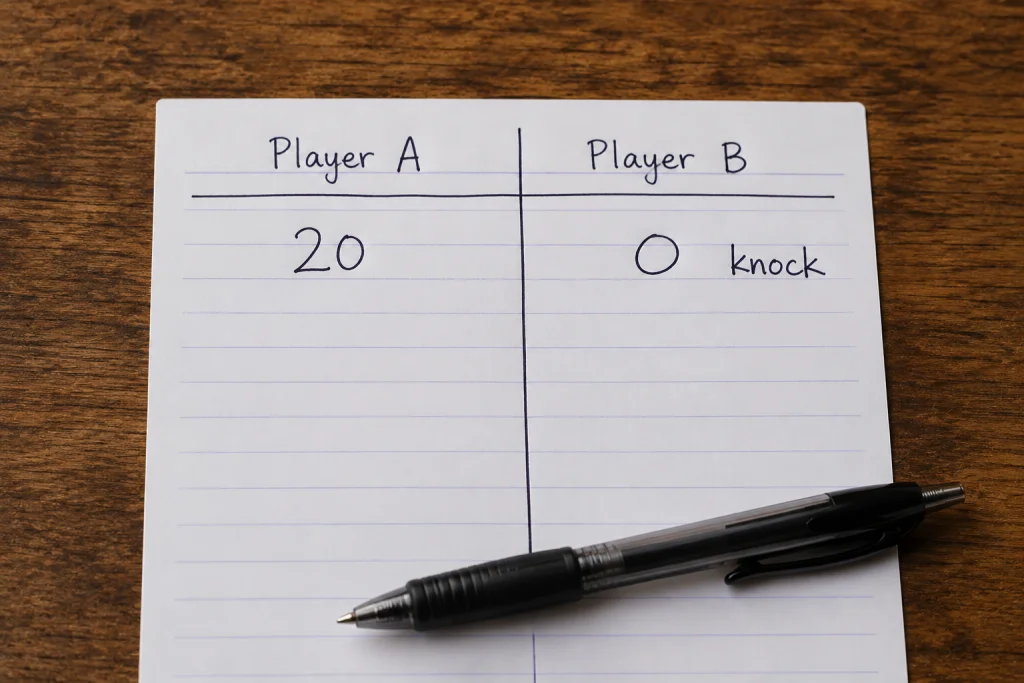
Score: 25 − 5 = 20 points for Player A
Scoring Summary Table
| Situation | Winner | Points scored |
|---|---|---|
| Knock, opponent has higher deadwood | Knocker | Deadwood difference |
| Knock, opponent equal or lower (undercut) | Opponent | Difference + 25 bonus |
| Go gin | Gin player | Opponent’s deadwood + 25 bonus |
How a Game Is Won
Most Gin Rummy games are played to 100 points.
Players:
- Keep a running score after each round
- Deal new hands
- Continue until one player reaches or exceeds the target score
End-of-Game Bonuses
Once a player reaches 100 points, additional bonuses are calculated on top of the running scores.
Game bonus: the winner receives +100 points for winning the game.
Line bonus (box bonus): each round won during the game earns a line. Each line is worth 25 points at the end.
Example: Player A won 7 rounds → 7 × 25 = 175 points in line bonuses.
Shutout bonus: if one player wins every round and the other player scores zero points during the entire game, the winner’s score is doubled before bonuses are added. This is rare but creates a large swing when it happens.
Full End-of-Game Score Example
| Category | Player A | Player B |
|---|---|---|
| Round scores total | 118 | 52 |
| Game bonus (winner) | +100 | — |
| Line bonus (rounds won) | 6 × 25 = +150 | 2 × 25 = +50 |
| Final total | 368 | 102 |
Player A wins with 368 points.
Some groups skip end-of-game bonuses and play to a simple 100-point target — agree before playing.
Common Scoring Mistakes Beginners Make
Forgetting layoffs before counting deadwood
When your opponent knocks, always check their melds carefully before announcing your total. A layoff or two can significantly reduce your deadwood — sometimes enough to undercut.
Knocking without checking opponent discards
If your opponent has been throwing low cards and holding everything else, they likely have a strong hand. Knocking with 8 or 9 deadwood in that situation is high risk.
Misunderstanding the undercut
Equal deadwood still produces an undercut — your opponent wins even if the difference is zero, because the 25-point bonus still applies.
Miscounting deadwood before knocking
An illegal knock (deadwood over 10) is an embarrassing and costly mistake. Always recount before announcing.
Assuming gin is always worth waiting for
Sometimes knocking with 4 deadwood now is better than waiting 3 more turns to go gin — especially if your opponent is drawing aggressively.
Understanding scoring helps you make better decisions before the round ends.
How Scoring Affects Strategy
Once you understand scoring, you’ll notice:
- Sometimes it’s better not to knock — especially if your opponent’s discards suggest a very low deadwood hand
- Reducing deadwood by 1 or 2 more points before knocking can be the difference between winning and being undercut
- Watching opponent discards helps you estimate their deadwood and decide whether knocking is safe
- Going gin eliminates layoff risk entirely, which often makes it worth the extra turns
Scoring knowledge directly impacts win rate.
👉 For gameplay context, see: How to Play Gin Rummy
👉 For full rules overview, see: Gin Rummy Rules
Gin Rummy Scoring FAQ
How many points do you get for gin?
Usually 25 bonus points on top of your opponent’s deadwood total.
What is the maximum deadwood to knock?
10 points or less in standard Gin Rummy.
Can you lay off cards when someone goes gin?
No — layoffs are only allowed after a knock, never after gin.
What if both players have equal deadwood after layoffs?
The non-knocker wins with the 25-point undercut bonus. Equal deadwood always goes to the non-knocker.
What happens if the stock pile runs out?
If neither player can knock and the stock pile is exhausted, the round is typically declared a draw and redealt with no score recorded. House rules may vary.
Is the 25-point gin and undercut bonus standard?
It is the most widely used amount. Some groups play with 20 or 30 — agree before the game starts.
Final Thoughts
Gin Rummy scoring isn’t complicated — but it’s precise. Once you understand how deadwood, knocking, gin, and undercuts work together, decisions become clearer and less risky.
Most players don’t lose because of bad cards. They lose because they misunderstand scoring.
👉 Ready to practice scoring decisions?
Best Gin Rummy Apps